Showing posts with label gear. Show all posts

Monday, June 9, 2014

Leica M6 TTL and first rangefinder experience


This is a small review on the Leica M6 TTL after 9 months of use, a general impression of a SLR user using a rangefinder intensively for the first time. Used as a personal camera, the overall impression is very positive and mechanical limitations disappear after several rolls (a ‘professional’ use hasn’t been made until now).

For non-intensive readers, the following lines resumes the whole post. 
 

Dislikes


  1. Patch flaring! Sometimes I’m seriously considering the viewfinder upgrade
  2. The meter works only when the shutter is cocked (but then it’s a cocking indicator)
  3. The sync speed intermediate step is annoying when turning the speed dial as it’s an intermediate step and “brakes the movement” (note: corrected on the M7)
  4. Fragile rangefinder mechanism compared to SLR’s? (only time will tell)

Likes

  1. Very small lenses (easily pocketable)
  2. Precise focusing mechanism (low rate of OOF pictures)
  3. Compact body
  4. Quiet, unobtrusive
  5. New friends (see further)

Framing and focusing

Being a “native”, long term SLR user as opposed to people using RF’s since their beginnings, the late transition to a rangefinder system is somewhat disturbing as it has several radically different characteristics:

a.       With a rangefinder, you look always through the same finder, disregarding the used focal length as they are materialized only with the framelines. With a SLR, what you see is what you get. So when your mind is used to frame accordingly to what you see in the viewfinder, you’ll be destabilized with your first rolls with your RF in “action situations”: On my M6 I’ve a fixed field of view of a 28 mm focal length even if I’m using a 50 mm. However, I was entirely accustomed to the framelines after several months.
b.      Focusing is only possible (and visible) within the patch area, the rest of what you see doesn’t reflect the actual focusing situation compared with a SLR where you see directly the FOV effect (when used wide open) and the focusing accuracy.
c.       Depending on the used lens, the focusing physical “interface” changes: some have a focusing tab moved with only one finger which has to be correctly placed in it to easily rotate the focusing ring whereas other lenses have a traditional “circular” focusing ring like any other SLR lens. Making small corrections with the first mechanism at certain positions (e.g. at infinity with the Voigtlander 35 mm f/1.4) is sometimes difficult as your finger gets in an uncomfortable position.
d.     From what I’ve seen on my first rolls, my overall focus accuracy was either spot on or really out of focus. Shooting at very large apertures with wide angles is much (much) easier than with a manual SLR as well as in low light situations. This is one major benefit of using a rangefinder, and especially a Leica where the base length is longer than a Voigtländer R for instance.

3      Action

Unless by working with hyperfocal settings (thus in bright situations) or in predictable situations where prefocusing is possible, action photography is quite hard with a fully manual rangefinder camera (also with manual SLR’s).Due to the limited film/money resources, you can’t “spray and pray” to get something well exposed and/or sufficiently well focused. 
 

4      Speed

When I’m shooting, I’ve three steps: (1) guessing the exposure and setting the speed/aperture combination, (2) correcting it if needed with the light meter, (3) focusing (and of course framing’n shootin’).The presence of a light meter is a plus when you’re not confident enough to (correctly) guess the appropriate exposure but with time and practice, the light meter becomes unnecessary except for certain situations. After a half dozen of rolls, I was able to guess the exposure in any situation with approximately half a stop difference with the meter reading. Note that it’s a spot metering so it can be fooled depending on where you aim.
 

5     Fragility

Compared to a SLR, the rangefinder mechanism seems prone to misalignment and is sensible to shocks and general abuse. I often tend to “live” with the camera and my SLR’s were used to getting banged on everything when kept on my shoulder or in my bag, as I’ve purchased quite recently (several months), I’m not mentally prepared to take it in places where I would only take a worn out 5D with countless actuations. My M6 came with a vertical alignment shift though it was impossible to tell whether it was due to the transporter or already present before purchase (note: buying a camera like this in a physical store, even second hand, has its advantages).

6      Compared to a manual SLR, Nikkormat FT2


The Nikkormat has a more solid, confident feeling, more than a Leica in my opinion (but you feel that the inner mechanics are much better on Leica’s). It weighs more than the M6 and feels immune to shocks. It shows the selected speed and the light meter is represented by a needle oscillating between two points, active when the rewind lever is off its neutral position. This meter representation is more intuitive as you can somewhat evaluate directly if you’re strongly under/overexposed or quite near of the ideal value, compared to the Leica’s LEDs. I wouldn’t hesitate to let it take a few shocks in my bag. I’ve used paired with a 50mm f/1.4 and it’s very comfortable to use for a fully manual SLR. And speed values are shown in the viewfinder.


7      Compared to a digital SLR, Canon 5D mark II


For me, shooting film is 50% for the grainy look and colors, and 50% for the pre-scan excitation. Each film that I processed is like a Christmas/birthday present when it comes to discover the results!

My Leica is for fun, my Canon for the rest. I am a fervent zoom supporter for professional assignments (reportages, action) but for personal I work, I can’t lug a 5DII and a zoom around my neck all day. Since I have the M6, I’m used to compactness and lightweight bodies, even a 5D with a 35 mm f/2 is nearly too heavy (but very polyvalent and compact compared to other SLR combinations).

After fighting with manual film cameras, going back to a camera like the 5D that doesn’t empty your wallet each time you press the shutter release is always nice! If I’ve bought a Leica several months ago, it’s mainly because I’ve extensively used my 5D’s before and because I’ve haven’t as much professional assignments as before. I carry my M6 quite often at parties, dinners and events as it’s discrete (both in size and operation) and analog (anyone can’t see the pictures before the film hasn’t been processed). With a 5D, it’s not the same: it’s big, loud and intimidating!

Film and digital are for me complementary: if I’m going on holiday with my Leica, I’ve always my compact Canon S110 with me for snapshots.

The 5D is another world compared to a rangefinder camera; it’s big, robust and polyvalent. Shooting with a rangefinder involves some limitations but I don’t think I would take my 5D and my Leica togesther at the same time. It allows me to think and shoot only in a film rangefinder perspective and moreover, what I can do with my Leica I could do exactly the same with my 5D. So to avoid any (hefty) redundancy, as the 5D mark II is definitely heavier and especially bulkier, I take either one or the other with me when I’m travelling light. But weight is definitely noticed when I’ve a zoom attached, like the EF 16-35 L, so I quite always opt for the 35 mm f/2.

8      Costs

As for today, a HP4 Ilford B&W 36 frames film costs 6 euros. Film processing and scan costs 14 €. So 20 € for 36 frames equals to 0,55 € per shot.

Shooting film today is more an aesthetical choice rather than a purely functional decision. Shooting a Leica, with or without Leica lenses is another one. There have been many discussions regarding costs when it comes to compare the whole (same format) system of film versus digital where it was assumed that film cameras were cheaper than their digital counterpart:


Conclusion


The Leica M6 TTL has many advantages compared to a film SLR: there are many fast lenses which are very small, the shutter mechanism is quiet and focussing at very large apertures is much easier since the Leica has a long rangefinder base length. It's very well built, but just as my Nikkormat FT2.

The body is quite expensive, as are Leica lenses... what you can get for a 5D mark II and several L lenses is somewhat the same as a Leica M-whathever with several Leica lenses (assuming you buy them second hand). Or you can sell one of your kidneys, it's up to you, at the end you must be able te determine whether you really need Leica quality or if you can survive with third party lenses like Voigtländer or Zeiss, but that's a subject for another post I guess.

Bottom line, if you need a small camera, with small lenses, if you like shooting wide open, if you can justify the costs of a Leica by getting pictures you like and sharing them with your friends (assuming they like them also), and taking in account all the likes/dislikes I mentionned above, then you can be ready to try the Leica experience.

Don't be a pussy, ditch your Mamiya/Contax 645 with that ridiculous AF system and get a gentlemen's camera (and keep that Pentax 67).

To be followed by: Camera Porn, Voigtländer lens reviews (35mm f/1.4 and 21mm f/4) and the truth about Kennedy's death (what the government doesn't want you to know).


London, March 2014 - Ukrainian protesters

Belgium, May 2014 - Contax stealthiness

Brussels, May 2014 - random Contax users


Leica M6 TTL + Voigtländer 35mm f/1.4 + Ilford FP4


Random Pentax 67 user, "just keep it" #randomthought


Saturday, May 7, 2011

When vision meets satisfaction

There's vision...

      I’ve been still shooting film when I began to use digital. At the time I had so much pleasure discovering the pictures that I took sometimes one month before having the roll processed, and I was keeping practicing in order to achieve the mystical “100% keepers”.

      Patience and vision were at the time the most important things for me, as I worked with what I called the “one – one” technique ; one roll for one project. Thirty six (or 24) images to summarize, to capture the spirit of a birthday, an unordinary event, a week-end with friends in the middle of nowhere, being on duty or free of anything. Identifying the key moments was a hard task. Sometimes you know that it will happen and you place yourself where you’ll be able to catch the scene as you want it. Swapping lenses, change your aperture, move, move, wait, pre-focus, focus, clac. And you know that it will be good. But you won’t be sure of that until you’ll have your pictures back from the shop. You open your folder and you make a quick overview: can somebody feel the action or the passion even if he wasn’t here? If yes, congratulations. If not, try again.

This was the relationship between me and my camera.

The camera was 30 years old and I had to carry at least two small screwdrivers because of frequent shutter jams in the middle of an event. That day I broke the shutter release mechanism of my trustworthy Minolta X-300 at the beginning of an important event where I had a dozen of precise pictures in my head to be shot throughout the day. I was disappointed, but these things happen.

      I didn’t buy another one even if I knew that the cropped sensor of my Pentax k20d couldn’t give me the same image rendition which I was used to see with my fast primes.

So I took the decision to save for a full format DSLR. This was 3 years ago.

      Today, after an endless search, it’s there. An old 5D classic. Now, fifties are fifties, 1.4’s are bokeh monsters, blur equals blur and viewfinders are bigger than ever. Photographic love is back. I've found the camera that I needed.

Rendition with a full frame camera is miles away from standard APS sized sensors
© Quiet Leaf


...And satisfaction

Many Pentax users took the Nikon way so why did I took a Canon?

This is where everyone has his own “gear philosophy”.

For me, no matter which camera; as long as it meets my shooting style, it’s good. I'm an amateur, not a pro.
I replaced my 35mm film camera by a 35 digital camera because I knew that it would meet my needs.

      I don’t expect a camera to be the best one, it has its own flaws and every photographer knows that he has to work with them, no matter what; go beyond your gear and focus on your pictures. I’ve been through this common problem of being more focused on cameras than my work, and it’s a real stopper. You’ll forget the reason why you’re here: you are a photographer.

      My Minolta was my workhorse camera; I learned the most important part of my technical skills with it. Aperture, Speed and Focus. Patience and vision. Once these are mastered, you can move forward and begin to know your camera and your lenses, be aware of their flaws and their qualities, don’t expect them to take the shot for you.

      This whole process had a significant impact on me: if one of my pictures was slightly out of focus or a little bit blurred, I didn’t really care, if it was overexposed, I would still be satisfied. Why? It wasn’t because of my gear, it was because of me. So it could be improved.

      Find the tools that suit your needs. Use them. Look at your pictures and find how you could improve them. Share your work and let it know around you. Print a dozen of pictures and hand it to your friends. They’re part of your photographic life, their satisfaction is also yours.

     If I had only one advice for everyone who wants to keep up with his passion, it would be this one. Ask yourself, when are happy with your work?

When your vision meets your satisfaction.

I’d love to hear your thoughts about this.

Cheers.

Saturday, February 19, 2011

Pimp My Lens – Keep them protected!

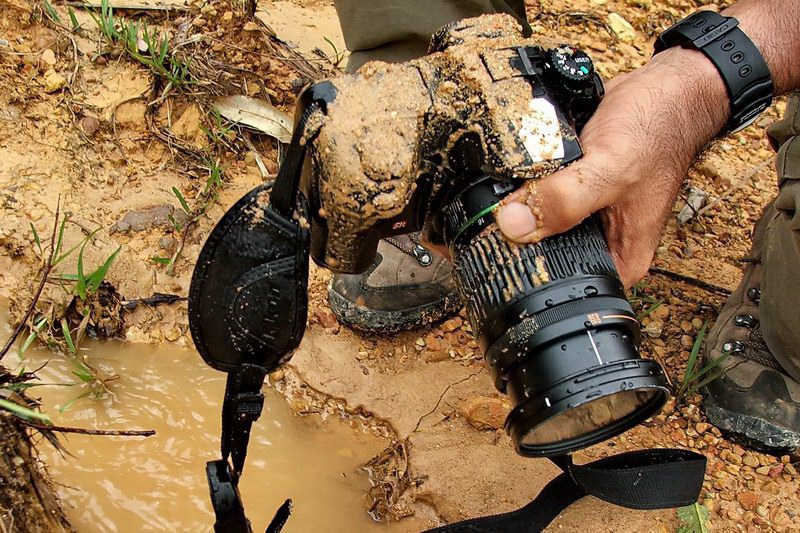
For those who use their equipment in dirty environments, we know that some parts of our lenses are dust-magnets or difficult to clean at the end of the day; rubber grips, rubber focus rings, etc. ...
 
Other parts are often in contact with abrasive surfaces; the bottom of the camera, the part of the lens that hits the table when layed down, the LCD screen,...

This can happen, too
© Rabani "k10d mudbath" on trekearth.com

A simple technique to prevent some unwanted mishaps or long cleaning nights is to tape the sensitive parts. It’s important not to use tape that leaves residues on the surface but tape used by electricians to seal contacts or tight up wires. 

They come in all sorts of colours
© Quiet Leaf

 It can also be used to hide our big white Canikontax markings on the front of the camera or other signs revealing that you’re walking with your brand new Nikon D4 or 5d mark III. Or our white lenses.

Cheers!

Taped Sigma 10-20mm
© Quiet Leaf

Sunday, February 13, 2011

Dilemma: Quality vs Speed

I’ve been shooting Pentax since 2007 and never disappointed by the overall image quality, from colour response to jpeg renderings. I had the opportunity to buy a 2nd hand eos 40d three months ago and inevitably after several hundred shots some comparisons are made. 

Before digging in the systems, the two contenders are completely different cameras by their use, so comparing them isn’t really adequate. The k20d is a robust landscape-traveller’s camera, has a strong resolution of 14,6mp (10mp with Canon) and high quality jpegs settings that allows you to drop the raw format without too much loss.

The weathersealing of Pentax is a blessing in rough climates
Vietnam, Mekong Delta in 2010
© Quiet Leaf
 
It may sound quite amateur-ish when I say “art filters are a real advantage” when nearly everyone has lightroom or aperture to do all the post processing when back  home. But here’s all the problem, “when you’re back home”! It’s not impossible for some travellers to go away for weeks or months in places with little or no electricity or where computers are completely unknown. So when you come back at home with thousands of pictures and you have to select the good ones or view them in B&W or any other post processing, the amount of work takes days and days to be achieved. When I was in such situations, at the end of the day or between two flights, I frequently used the in-camera processing to preview some effects on the pictures that I liked and it considerably helped me sorting out these huge folders when I had to work out all the memory cards. As I said, it may sound a little bit odd but it spared me so much time that it was a small regret when I saw that the 40d didn’t have all these elements. But nevertheless, it wasn’t a deal breaker at all.

The eos 40d is more a sports-lifestyle camera; 6.5 fps with a silent and quick autofocus. The USM alone is a real advantage against the Pentax counterparts: it’s a mature technology that comes with nearly all types of lenses, the “cheap” ones just as the latest telephoto, and combined with the fast autofocus, it’s a real pleasure to work with such an efficient tool.

The excellent autofocus of the eos 40d helps a lot
© Quiet Leaf


In normal conditions, the autofocus is precise 80% of the time and the rest is slightly out of focus BUT the picture is there and that’s THE huge advantage opposed to Pentax. The 40d searches focus quickly, doesn’t find it but releases the shutter even if it’s not perfectly in focus; the k20d hunts, hunts, ... and locks way too late, when the subject/moment is gone. So on one side we’ve got an OOF picture and on the other side... nothing!
Metering with canon is “spot-on”, you know that the object that you want to be shown will be well exposed, even at the cost of burned skies or blown highlights. Pentax will almost always have an underexposed image. But it turns to be a real advantage for Pentax. And it’s so important for people who post process their images, the Pentax JPEGs can be reworked afterwards so well and handles exposure/colour changes with a greater magnitude than the Canon ones (ok, there’s RAW for that, but for long hi speed sequences it’s not ideal). What you win on one side you lose it on the other side!


In-body stabilisation is a huge plus for Pentax, EVERY lens is stabilized; primes, old lenses, cheap lenses,... but it’s not as effective with longer focal lengths than the IS system. For shorter focal lengths (UWA, 50mm’s,...) it’s PERFECT. IS is a real step over Pentax for long range shooting.


Now the ultimate point, image quality. To be fair, I’m not a great fan of Canon’s IQ. Or at least with the 40d. Colours are good but not always correct and noise suppression is quite heavy. Pentax’s IQ is a real step forward Canon’s, especially with colour fidelity. But as said before, we’re speaking of two different sensors, the landscape one and the “fast” one. Newer models as the eos 7d and the k5 will have certainly changed this situation. 
 

For a software point of view, the k20d is filled with so many bonuses (built-in intervallometer, micro-adjust, in-body shake reduction system,...) that the 40d seems with nothing more than the customizable “quick menu” that the k20d doesn’t have. But it's so handy and saves you some precious seconds...!

Il’ll achieve here with some rapid thoughts about the overall handling. The grip of the 40d is deep enough and higher than the k20d, and using it with gloves doesn’t make it difficult; I didn’t feel the need of a additional grip to hold firmly the camera. The k20d is smaller but needs a grip when you shoot with gloves otherwise it slips too easily out of your hands. 

The top LCD screen of the Pentax is easier to read/check rapidly. Even if it’s smaller than the Canon, shutter speed and aperture are impossible to miss at a distance of 40cm. The Canon one is overcharged with too many information (even if they’re useful, e.g. WB and remaining shots) and difficult to read. The rear screen of the Pentax is far more accurate than the Canon one (resolution and color rendition)

Pentax k20d
© Quiet Leaf

EOS 40d
© Quiet Leaf

So, speed or quality?

Go Pentax if you travel and if you'll face tough weather conditions, if you have time to compose and to make good use of its 14,6mp. Go Canon if you need a excellent, quiet and reactive camera.

It’s just the beginning with Canon, I’m discovering it, and my judgment will surely change over time but here are the first impressions with the two systems. To be continued!

Saturday, February 12, 2011

Pentax FA* 300mm f/4.5 review

Build quality / Handling


Pentax Fa* 300mm f/4.5
© Quiet Leaf

From the professional grade lenses of Pentax back in the 90’s, this lens is built like a tank. It’s solid, heavy (935g) and seems ready to take years of abuse. The front element is recessed for 1cm into the lens body and doesn’t protrude at all, keeping it safe from any direct hit when the lens hood isn’t on.

The aperture ring is made of plastic and goes from f/4.5 to f/32, the focus ring has a push/pull mechanism to control the focus. Note that if you want to set it on manual, you must change it from the lens, the switch on the body isn’t enough on its own.

FA* 300mm f/4.5 and Canon 70-200 L f/4
© Quiet Leaf


The lens came without lens hood, and I was a little bit worried by the lack of a proper flare protection but after several hundred shots under bright and direct light right into the lens, the need of one rapidly vanished as the lens doesn’t suffer at all from ghosting or flaring. I used to screw a rubber shade on it but it was more in order to protect the lens when I had to put it on a rough surface.

Be careful, even if it’s a FA*, the lens IS NOT weathersealed!
But fortunately it can be easily taped (albeit you lose the manual focus option).

Pentax FA* 300mm f/4.5 and Canon EF 70-200 L f/4


The lens is sufficiently small to be carried around without too much last; it has a filter thread of 67mm (compared to the DA* 300mm f/4 which is 77mm) and measures 16 cm long. It can be put in a regular shoulder bag when mounted on a camera + grip, and taken in and out without too much hassle. Since it’s so small for a 300mm and with a silver coating, it doesn’t attract attention compared to the grayish Canon 300mm L counterpart (16 cm vs 21,3 cm).


Autofocus

As usual, the autofocus mechanism is on the noisy side, you don’t have the speed nor the quietness of a SDM / USM motor. But you can be sure that it will never let you down – screwdrives lasts forever!

For static and slow moving objects under good light conditions, the autofocus is quick and precise; but when it comes to fast actions e.g. football players or rally cars, it tends to be a tad too slow to catch the right speed in order to freeze in focus the spot that you want. In 60% of the situations, the picture will have a slight blur due to this delay (estimated number after lots of open air sports shooting)... But we’re talking about fast and unpredictable movements, so for most users it won’t be an issue here. Wildlife and lifestyle photographers will be overly satisfied with this lens but sports shooters must look to other options (with SDM / HSM equivalents – or a faster autofocus system, but that’s another debate).

NOTE  

The lens was tested on a k20d, but results may vary with the new k5 since it has a new in-body motor and a new autofocus type.


Image quality

Wide open and with the long focal length, it delivers a decent bokeh (8-bladed diaphragm, but remember that we’re talking about an f/4.5 lens on APS-C, so it’s more like an f/5.6 bokeh) and an excellent level of detail and contrast. It’s tack sharp when stopped to f/5.6.

The 8-bladed diaphragm
© Quiet Leaf

The K-mount and the aperture ring
© Quiet Leaf

It’s one of the few lenses which I had the “wow” surprise when pixel peeping pictures at 100%. The amount of detail was absolutely stunning, on par with the FA 50mm 1.4 at f/4. With the FA* and the 14.6 mp of the k20d, I kept going deeper and deeper in the picture, I was still able to crop it and stay with an excellent picture.

Working with JPEG’s and AWB, colours were naturally saturated and contrast was very high. All in all, it’s a lens that has an excellent piqué... I was seeing here the benefits of Pentax’ Super Multi Coating, one of the company’s best strengths. No flare, no CA. A real gift for every photographer.
In the field

Mounted on a k20d with the battery grip, the lens is very well balanced for shooting handheld but lacks the tripod collar when it has to be mounted on a mono or a tripod. Several owners use the tripod collar of the Canon 70-200mm f/4 (or equivalent) without any trouble, there’s just enough space between the aperture ring and the scale window to attach it there. On its own, when the camera and not the lens is mounted on the tripod, the camera can’t handle the 935g without trouble and suffers from disturbing vibrations. You can use it handheld (but I would consider a handstrap) and at the end of the day you won’t suffer so much from the wheight (but not if you’re shooting continuously for 1 hour).   

The FA* mounted here on the k20d
© Quiet Leaf


Pentax k20d and FA* 300mm side by side
© Quiet Leaf


Conclusion

When I found it in a second hand shop, I didn’t realized at first how lucky I was; for the price I paid (around 600€ - used - but with the autofocus mechanism cleaned and calibrated, no other problems) this lens is a must-have for light and tough travellers. The metallic outer shell inspires so much confidence that you know that you can use the beast everywhere, it’s small enough to be carried around – we’re talking about a 300mm! – and comes with a screwdrive mechanism that will never fail, and image quality on the bests levels.

All in all, this lens is hard to find (in France/Benelux, I see sometimes one once a year on the 2nd hand market, no more) but if you can grab it, you won’t regret it.


Nearly 1kg of metal and glass, this lens is  nearly indesctructible
© Quiet Leaf


 f/4.5, ISO 400, k20d
© Quiet Leaf